
What Probate Covers in Colquitt County
Colquitt County Probate Court is the local court source for probate matters and related statutory functions. The official county page links to Georgia Probate Records for marriage-license and weapons carry license applications, the Council of Probate Court Judges standard forms, a probate document center, certified marriage certificate requests, and election information. Those links confirm that probate records are managed outside the Clerk of Superior, State & Juvenile Court's Superior and State case-search lane.
Estate records can include petitions to probate a will, petitions for administration, will copies, death certificate references, heirs and beneficiaries, fiduciary oaths, bonds, letters testamentary or letters of administration, creditor notices, inventories, appraisals, annual returns, final returns, discharge orders, and related notices. Guardianship and conservatorship files can include petitions, evaluations, appointment orders, reporting requirements, and protected medical or minor-related information.
The local distinction is important because the Superior Court Clerk may record deeds or land instruments that arise after an estate transfer, but the estate case itself remains a Probate Court matter. A user checking title after an estate may need both routes: Probate Court for the petition, will, letters, and orders, and the clerk recording side or GSCCCA for any later deed, lien, plat, or recorded instrument. Those are connected records, but they are not the same file.
The official Colquitt County Probate Court page is the central local page for probate users. The screenshot below reflects the county source that links the probate, marriage, weapons carry, forms, and certificate channels.
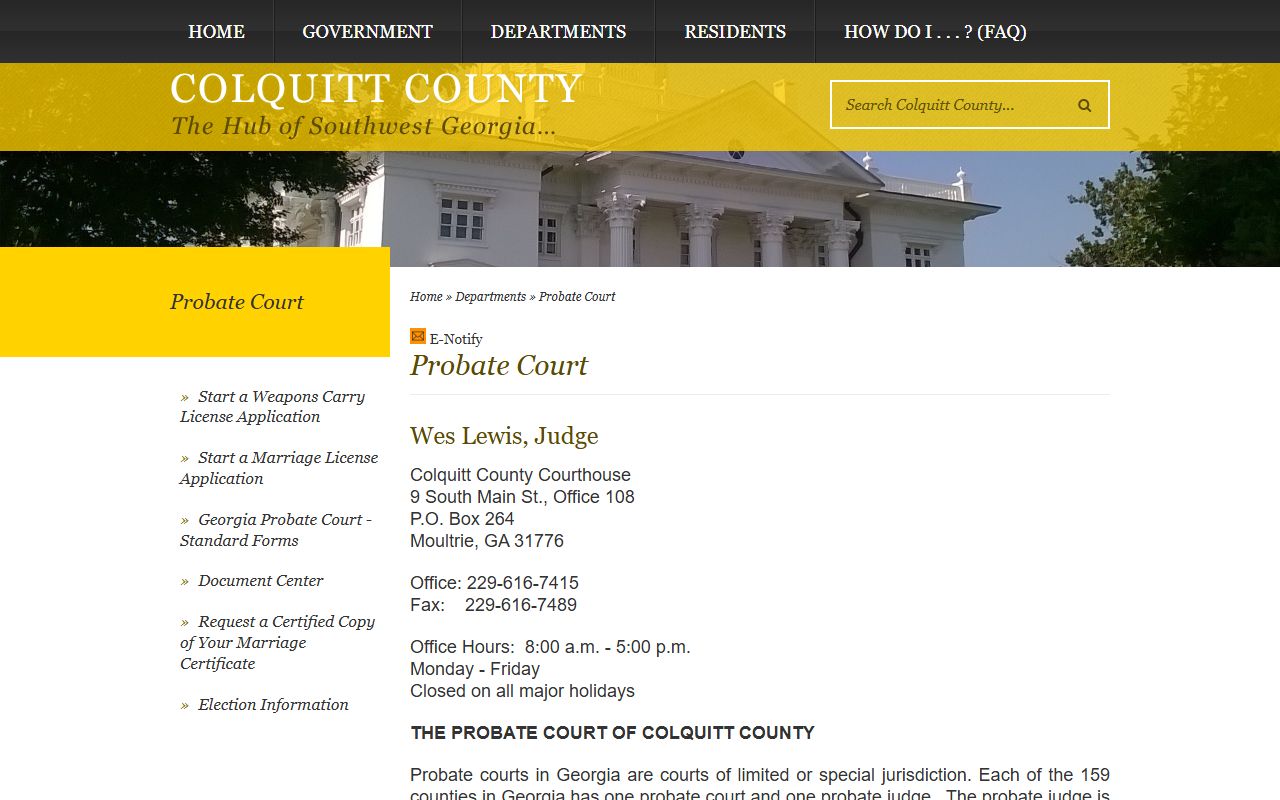
Because the research did not locate a separate probate phone number or room number in the reviewed excerpt, users should route office-specific questions through the official county Probate Court page or county directory rather than assuming the Superior Court Clerk can access estate case files.
Probate Terms Defined
Probate filings use a compact vocabulary that appears in petitions, orders, and copy requests. Understanding the terms helps identify the document needed before contacting Probate Court.
- Petition
- The filing that asks Probate Court to open an estate, appoint a fiduciary, admit a will, or enter another probate order.
- Will
- A written document stating how property should pass after death and who should carry out the instructions.
- Executor
- The person named in a will to administer the estate after appointment by the court.
- Administrator
- A fiduciary appointed when there is no valid will naming an executor or when the named executor cannot serve.
- Intestate
- Dying without a valid will, which usually requires administration under Georgia law rather than probate of a will.
- Letters
- The court-issued proof that a fiduciary has authority to act for an estate.
- Inventory
- A filed list of estate property, when required by the court or applicable probate rules.
- Guardianship
- A proceeding involving authority over personal care decisions for a minor or adult when legally appropriate.
- Conservatorship
- A proceeding involving authority over property or financial matters for a protected person.
How to Search Colquitt County Probate Court
Colquitt probate access is a channel-based process. The county page links online applications for marriage and weapons carry licenses, Georgia Probate Court standard forms, a probate document center, and FeePayOnline for certified marriage certificates. The reviewed research did not locate an online estate docket search showing public estate case images. Older files, estate petitions, wills, guardianship orders, and non-digitized records may require a Probate Court request.
Before calling or visiting, narrow the request to the record class. Marriage certificate copies route through the certificate vendor linked by Probate Court. Marriage-license applications begin through Georgia Probate Records. Weapons carry applications also use Georgia Probate Records. Estate and guardianship files are more likely to require direct Probate Court handling, especially when the request involves certified copies, sealed exhibits, fiduciary authority, or older paper material.
- Identify the record type: estate, will, guardianship, conservatorship, certified marriage certificate, marriage application, or weapons carry application.
- Use the official Probate Court page for the matching link, including Georgia Probate Records, FeePayOnline, standard forms, or the probate document center.
- For estate or guardianship files not shown online, contact Probate Court through the county page or directory with the decedent or ward name, approximate filing year, petitioner name, and document needed.
- Ask whether the document is public, restricted, sealed, or available only to a party, attorney, fiduciary, guardian, conservator, or person with a court order.
The Georgia Probate Records Colquitt weapons carry application page is one of the official/vendor probate-linked application routes. The image below shows that probate users may encounter state/vendor workflows even when starting from the county court page.
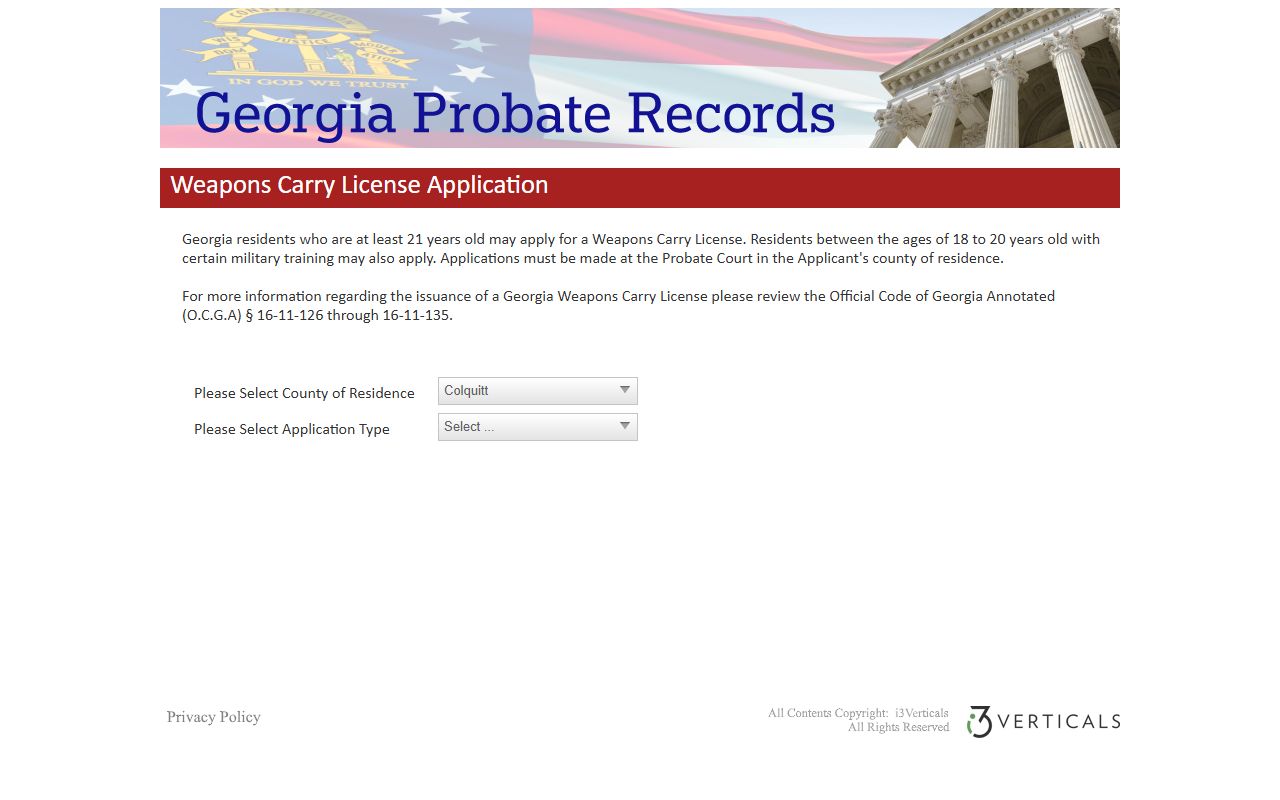
Those application workflows do not replace direct Probate Court access for estate files. They are useful for the specific application categories linked by the local court.
Probate Courts in Colquitt County
Colquitt County has a dedicated Probate Court page under county departments. The research did not locate a separate judge name, phone number, or exact probate room in the reviewed official excerpt. The contact card therefore uses the official web routing and states the gap plainly rather than inventing a phone number from another court office.
Colquitt County Probate Court
Official county Probate Court page
Moultrie, GA
Phone not located in official sources reviewed
Use the official county page or courthouse directory for current office routing.
Probate Filing Fees
The reviewed official county research did not publish a complete local probate fee schedule. Use the table as a source-status guide and confirm the current cost with Probate Court before filing or requesting copies. Certified marriage certificate copies are routed through FeePayOnline, where the fee is calculated during the request workflow.
| Item | Amount |
|---|---|
| Estate filing | Fee not located in official county sources reviewed. |
| Guardianship filing | Fee not located in official county sources reviewed. |
| Letters testamentary or administration | Fee not located in official county sources reviewed. |
| Certified marriage certificate | Requested through FeePayOnline; exact amount not captured in official page text reviewed. |
| Standard probate forms | Linked through gaprobate.gov as public form resources. |
What Colquitt County Probate Records Show
Estate files usually identify the decedent, petitioner, heirs or beneficiaries, fiduciary, and the relief requested. Depending on the case, the file may include the will, petition, oath, bond, letters, inventory, appraisals, creditor notices, year's support petitions, annual returns, final returns, and orders closing or discharging the fiduciary. A copy request should name the decedent, approximate death or filing year, and the exact document needed.
Guardianship and conservatorship records can show petitioner, ward, proposed guardian or conservator, appointment orders, bond, reports, inventories, and court supervision entries. These cases often contain medical, capacity, financial, and minor-related material. Probate Court may provide a public docket or order while withholding exhibits, evaluations, or protected details.
Real estate documents created after estate administration can cross over to the Clerk's recording side when deeds or related instruments are recorded. That does not move the estate case file to the Superior Court Clerk. Search GSCCCA or the Clerk's recording channels for recorded deeds, liens, plats, UCC, and notary records, while using Probate Court for the underlying estate petition and orders.
| Probate Record Field | Why It Matters |
|---|---|
| Decedent or ward name | Identifies the person tied to the estate, guardianship, or conservatorship file. |
| Petitioner | Shows who asked the Probate Court to open the case or enter an order. |
| Fiduciary | Names the executor, administrator, guardian, or conservator appointed by the court. |
| Letters | Shows proof of authority for banks, title companies, agencies, and other third parties. |
| Returns and inventories | Track estate or protected-person assets when those filings are required and public. |
| Orders | Show the judge's ruling, appointment, restriction, discharge, or other probate action. |
Restricted Probate Court
Georgia law makes many public records available, but probate access has important limits. O.C.G.A. 50-18-70 et seq. and O.C.G.A. 50-18-72 recognize public-record access and exemptions, while court rules and specific confidentiality statutes can restrict case material. Adoption records are highly confidential. Mental-health commitment material and medical evidence are confidential or heavily redacted. Guardianship records may contain protected adult-capacity, medical, financial, and minor information.
Public estate docket material is generally more accessible than guardianship medical evidence, sealed exhibits, protected personal identifiers, or adoption-like confidential material. A person requesting copies should be ready to show party status, fiduciary appointment, attorney authority, or a court order when seeking restricted material. Nonparties should expect redacted copies when Social Security numbers, financial account numbers, protected addresses, minor information, or medical facts appear in a filing.
When the online links do not answer the question, make a targeted Probate Court request instead of a broad open-record request to an unrelated county office. The custodian that maintains the probate file is best positioned to explain whether a record can be inspected, copied, certified, redacted, or withheld.